
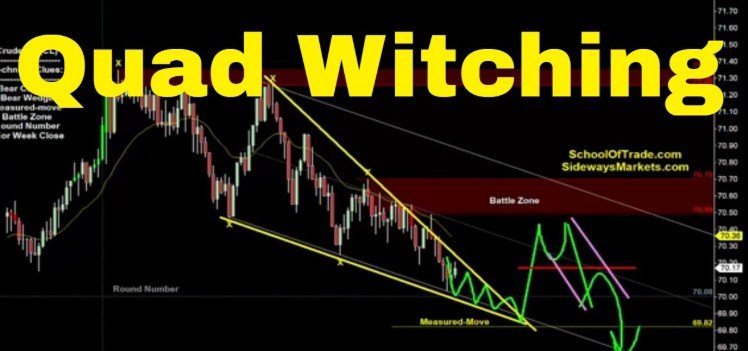
If you’re watching SPY chop around in an unusually tight range this morning while volume stays elevated, you’re witnessing the setup phase of one of the most volatile trading days of the year. Today—Friday, December 19, 2025—is quad witching, the quarterly expiration of stock index futures, stock index options, stock options, and single-stock futures all at once. Over $7.1 trillion in notional options exposure is set to expire by the close, and history shows that the real fireworks don’t start until the final hour of trading.
What Is Quad Witching and Why Does It Matter?
Quadruple witching occurs on the third Friday of March, June, September, and December when four types of derivative contracts expire simultaneously. The event forces institutional traders, market makers, and hedge funds to roll positions, close hedges, and settle contracts—all before the 4:00 p.m. ET bell. That mass unwinding and repositioning creates a surge in trading volume and volatility that can turn a sleepy Friday afternoon into a battlefield.
The numbers tell the story: on quad witching days, average trading volume jumps 50% to 100% above normal levels, with major ETFs like SPY often seeing multiple times their usual volume. The VIX typically rises 15% to 25% during quad witching weeks, signaling that implied volatility is elevated as traders anticipate the chaos. And the final trading hour—the so-called “witching hour” from 3:00 to 4:00 p.m. ET—can account for up to 40% of the entire day’s volume as last-minute hedging and settlement operations intensify.
The Historical Pattern: Bullish Before, Bearish During, Weak After
One of the most consistent patterns around quad witching is the weekly bias. Historically, the week leading up to quad witching tends to be bullish, with strong returns as funds and dealers position ahead of the expiration. But the actual quad witching day itself? That’s where things flip: quad witching Fridays have shown lower-than-average returns, suggesting a mild bearish tilt on the day. And the week following quad witching often turns negative, particularly in June and September expirations.
For traders, this means two things:
- Don’t assume direction—quad witching is not reliably bullish or bearish; it’s a volatility and liquidity event, not a directional bet.
- The edge is in managing the chop, not predicting whether SPY closes green or red.
The Morning Session: Fake Moves and Range Compression
If you’ve been watching SPY this morning, you’ve likely noticed something unusual: price is moving, but it’s not going anywhere. This is textbook pre-witching behavior. Dealers and institutions are positioning, hedging gamma exposure, and waiting for the real volume to hit later in the session. The result is often a compressed range with elevated volume but little follow-through in either direction.
For day traders, the lesson is simple: the morning session is a trap. Breakouts get faded, support levels hold temporarily, and what looks like a trend in the first 90 minutes often reverses by lunch. The smart play during this phase is to stay small, avoid chasing momentum, and use the morning chop to map out key levels for the afternoon explosion.
Mark these levels on your SPY chart before the witching hour hits:
- Yesterday’s high and low (magnet levels for pin risk)
- Overnight high and low from ES futures (institutional reference points)
- VWAP (the gravitational center; watch for reclaims or failures)
- Major gamma strikes (if you have access to options flow data, the strikes with the highest open interest are where dealers will defend)
The Witching Hour: 3:00 to 4:00 PM ET
This is where quad witching earns its reputation. As the 4:00 p.m. close approaches, three things happen simultaneously:
- Market makers rebalance delta hedges as options expire in-the-money or out-of-the-money, forcing them to buy or sell massive blocks of stock.
- Funds roll futures positions into the next quarterly contract, creating directional flows that can overwhelm short-term technicals.
- Retail and institutional traders close out positions to avoid assignment or settle expiring contracts, amplifying volume and volatility.
The result? SPY can rip $2 to $3 in a matter of minutes—then reverse just as quickly. Bid-ask spreads widen, liquidity thins despite the high volume, and “normal” support and resistance levels get blown through like they don’t exist.
How to Trade the Witching Hour Without Getting Destroyed
The cardinal rule: you are not smarter than the machine. The flows driving price action in the final hour are institutional, algorithmic, and based on tens of billions of dollars in hedging obligations—not technical patterns or retail sentiment. Your edge is not in predicting the direction; it’s in surfing the wave with strict risk controls.
Here’s a practical game plan:
1. Reduce Position Size by 50%
If you normally risk $500 per trade, cut it to $250 on quad witching. The increased volatility means your stops will get tested more aggressively, and getting whipsawed out of full-size positions will wreck your P&L faster than you can reload.
2. Widen Your Stops (and Accept It)
On a normal day, you might use a 5-tick stop on ES futures or a $0.50 stop on SPY. Today, widen that to 8–10 ticks or $0.75–$1.00. The noise floor is higher during quad witching, and tight stops will get you chopped out of what would otherwise be winning trades. Pair the wider stop with smaller size so your dollar risk stays constant.
3. Trade the Retest, Not the Initial Spike
When a big move happens in the final hour—say SPY rips from $583 to $585 in three minutes—don’t chase it. Wait for the pullback to retest the breakout level, confirm it holds as support (or resistance if bearish), then enter with a tight stop against that retest. This keeps you out of the worst whipsaw and ensures you’re trading with the flow, not against it.
4. Focus on the Final 15 Minutes (3:45–4:00 PM ET)
The very last stretch of the session is where the heaviest settlement flows hit. If you’re nimble and can stomach the volatility, this 15-minute window often produces the cleanest directional moves as dealers scramble to close hedges and funds finalize rolls. But this is advanced—if you’re newer to trading, it’s perfectly acceptable to step aside and watch.
5. Don’t Hold Positions into the Close
Unless you’re an institutional trader hedging a book, there’s little reason to hold a speculative position through the 4:00 p.m. bell on quad witching. Close everything by 3:55 p.m. at the latest. The risk of an ugly fill or an after-hours gap that wipes out your intraday gains far outweighs the upside of capturing the last tick.
Specific Strategies for Quad Witching Day
If you want to actively trade the event (rather than sit it out), here are three approaches that fit the environment:
Scalping:
The elevated volume and volatility create abundant opportunities for quick in-and-out trades. Focus on capturing 10–20 cents on SPY or 2–4 ticks on ES, using Level 2 order flow to spot aggressive buying or selling. This works best in the 3:00–3:45 p.m. window when volume is spiking but before the final chaos of the close.
Mean Reversion:
Quad witching often produces exaggerated moves that snap back quickly. If SPY surges $2 above VWAP in five minutes with no fundamental catalyst, that’s a mean-reversion setup: fade the move with a tight stop above the high, targeting a reversion back to VWAP. The key is waiting for extreme deviations, not fading every pullback.
Trend Following (with discipline):
If a clear trend emerges in the final hour—say, relentless buying that holds higher lows and keeps reclaiming VWAP—don’t fight it. Trade pullbacks in the direction of the dominant flow, using the prior 5-minute low as your stop. But be ready to flip: quad witching trends can reverse violently, and yesterday’s momentum is today’s fade.
What NOT to Do on Quad Witching
Just as important as knowing what works is knowing what doesn’t:
If you struggle with these behaviors, review the biggest common trading mistakes that blow up accounts.
- Don’t trade the open with size — The morning is all noise; save your capital for the afternoon.
- Don’t fight the volume — If institutional flows are pushing one direction, respect it; trying to call the top or bottom will get you run over.
- Don’t revenge trade — If you get stopped out in the witching hour, step away; the next trade will be just as volatile and twice as expensive emotionally.
- Don’t ignore risk management — Quad witching is not the day to “let it ride” or double down. Stick to your plan or sit out entirely.
After the Close: What Comes Next?
Once 4:00 p.m. hits and the dust settles, quad witching is over—but the effects linger. Historically, the week following quad witching tends to show negative returns, especially in June and September. That suggests some of the bullish positioning that built up ahead of expiration gets unwound in the days after, creating a mild bearish bias.
For swing traders, this means being cautious about initiating new longs into the weekend or early next week. Wait for confirmation that buyers are still in control before committing capital to multi-day holds. Conversely, if you’re bearish, the post-witching period can offer cleaner fade setups as the market digests the quarter-end flows.
Quad witching is not a day to prove you’re a hero. It’s a day to survive, stay disciplined, and let the institutional flows do the heavy lifting while you trade around the edges. The traders who make money today are the ones who size down, widen stops, and focus on the final hour—not the ones swinging for the fences at 9:45 a.m.
If the volatility feels too chaotic, there’s zero shame in sitting out and watching. Live to trade another day. But if you’re in the arena, respect the witching hour, trade the levels, and cut losers fast. That’s how you turn a Freaky Friday into a profitable one.

Leave a Reply