
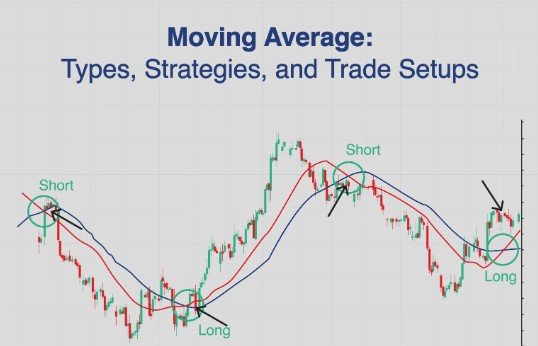
Moving averages trading is one of the most powerful yet simple techniques for identifying trends and timing entries. Furthermore, professional traders use moving averages to filter out market noise and focus on the dominant price direction.
What Are Moving Averages?
Moving averages smooth out price data by calculating the average price over a specific period. Consequently, they create a flowing line that helps traders visualize trend direction more clearly than choppy candlesticks. In essence, moving averages trading transforms complex price action into readable signals.
Simple Moving Average vs Exponential Moving Average:
Simple Moving Average (SMA)
The SMA calculates the arithmetic mean of prices over a set period by giving equal weight to all data points. For example, a 20-period SMA adds the last 20 closing prices and divides by 20. Therefore, the SMA provides stable trend analysis with fewer false signals in volatile markets.
Exponential Moving Average (EMA)
The EMA assigns more weight to recent prices, making it more responsive to current market conditions. As a result, the EMA reacts faster to price changes than the SMA. However, this sensitivity can also generate more whipsaw signals during choppy markets.
Which One Should You Use?
Day traders typically prefer EMAs because they need faster signals for quick entries and exits. Conversely, swing traders often choose SMAs for their smoother, more reliable trend identification. Ultimately, your trading timeframe determines which moving average works best.
Popular Moving Average Periods:
The most widely used moving averages create strong support and resistance levels because millions of traders watch them:
- 9 EMA: Ultra-short-term momentum for scalping
- 20 SMA/EMA: Short-term trend and pullback entries
- 50 SMA/EMA: Medium-term trend direction
- 200 SMA/EMA: Long-term trend and major support/resistance
These periods work well because they align with institutional trading algorithms. Additionally, the confluence of multiple moving averages at the same price level creates powerful zones.
Moving Average Crossover Strategy:
Golden Cross and Death Cross
A golden cross occurs when a shorter moving average crosses above a longer moving average, signaling bullish momentum. Meanwhile, a death cross happens when the shorter MA crosses below the longer MA, indicating bearish pressure. The classic combination uses the 50 and 200-period moving averages for these signals.
Dual Moving Average System
This moving averages trading strategy uses two MAs with different periods to generate entry and exit signals. First, identify the trend using the longer MA as your directional filter. Next, enter trades when the shorter MA crosses in the trend direction. Finally, exit when the crossover reverses.
Moving Averages as Support and Resistance:
Dynamic Support in Uptrends
During uptrends, price tends to bounce off moving averages as support levels. Therefore, buying pullbacks to the 20 or 50 EMA offers low-risk entry opportunities. Moreover, multiple bounces off the same MA confirm its validity as a support zone.
Dynamic Resistance in Downtrends
In downtrends, moving averages act as resistance where selling pressure increases. Consequently, short entries near the MA provide favorable risk-reward setups. Watch for rejection candles at the moving average to confirm resistance.
Advanced Moving Averages Trading Strategies:
Triple Moving Average System
The triple moving average strategy uses three MAs with different periods to reduce false signals. This approach confirms trend changes more reliably than dual crossovers. For instance, use 10, 20, and 30-period SMAs where all three must align before taking trades.
Moving Average Bounce Strategy
Instead of waiting for crossovers, experienced traders buy or sell bounces off key moving averages in established trends. First, confirm the trend direction using the 200 SMA. Next, wait for price to pull back to the 20 or 50 EMA. Finally, enter when price shows rejection with a strong candle close away from the MA.
Volume-Weighted Moving Average (VWMA)
The Volume-Weighted Moving Average incorporates volume data to give more importance to high-volume price levels. As a result, VWMA better reflects institutional trading activity. This makes it particularly useful for identifying where smart money is positioned.
Optimal Moving Average Settings by Trading Style:
Scalping (1-5 minute charts)
Scalpers need ultra-fast signals, so they use 9 and 20 EMAs for quick momentum plays. Additionally, the 50 EMA provides trend context on higher timeframes. Keep in mind that faster settings generate more signals but also more false moves.
Day Trading (5-60 minute charts)
Day traders commonly use 20 and 50 EMAs for entries with the 200 SMA for overall trend bias. Furthermore, the bounce strategy works exceptionally well on 15-minute charts during the first two hours of trading. Always align your trades with the direction indicated by the 200 SMA.
Swing Trading (daily charts)
Swing traders rely on 50 and 200 SMAs for cleaner signals with less noise. Moreover, the position sizing should increase when price respects these major moving averages. The weekly chart’s 20 SMA also provides excellent swing trade setups.
Common Moving Averages Trading Mistakes:
Many beginners chase every crossover signal without considering the broader market context. Similarly, using too many moving averages creates confusion rather than clarity. Instead, stick to 2-3 moving averages maximum and always confirm signals with price action.
Another critical error involves ignoring ranging markets where moving averages generate constant whipsaws. Therefore, identify trending conditions before applying MA strategies. When price chops sideways across your moving averages, step aside and wait for clearer trends.
Practical Tips for Moving Averages Success:
Start by observing how price interacts with the 50 and 200 moving averages on your preferred timeframe. Additionally, mark areas where multiple moving averages converge since these zones attract significant trading activity. Finally, combine moving averages with volume analysis for stronger confirmation signals.
Never rely solely on moving average crossovers for trading decisions. Instead, use them as one component within a complete trading system that includes risk management and market structure analysis. The most successful moving averages trading approach balances speed with reliability based on your individual trading style.

Leave a Reply