
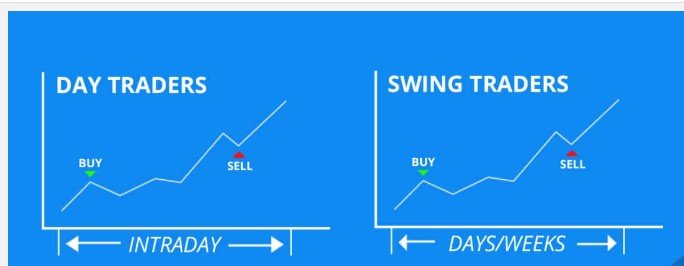
Choosing between day trading and swing trading is one of the most important decisions new traders face. Both strategies can be profitable, but they require different skill sets, time commitments, and personalities. Understanding the differences helps you select the approach that matches your lifestyle and temperament. Your choice also depends on how well you manage emotions, risk, and your overall trading plan
What is Day Trading?
Day trading involves opening and closing all positions within the same trading day. Day traders never hold positions overnight, eliminating exposure to after-hours news and gap risk. They make multiple trades daily, capitalizing on small price movements throughout the session.
Day traders focus on intraday timeframes—typically 1-minute to 15-minute charts. They’re looking for quick moves that might only last minutes or hours. The goal is to capture small profits repeatedly rather than waiting for large moves.
This strategy requires constant market monitoring during trading hours. Day traders sit in front of screens from market open to close, ready to act on opportunities. The intensity and focus required are significant—you can’t day trade casually while working another job.
Capital requirements for day trading are higher due to pattern day trader (PDT) rules. In the US, you need a minimum of $25,000 in your account to day trade stocks with margin. Below that threshold, you’re limited to three day trades per five trading days.
What is Swing Trading?
Swing trading involves holding positions for several days to several weeks. Swing traders capture larger price moves that develop over multiple days. They’re less concerned with intraday volatility and more focused on multi-day trends.
Swing traders use daily and weekly charts primarily. They identify setups that might take days or weeks to play out. A swing trade might last anywhere from 2 days to several weeks, depending on how quickly the thesis develops.
This approach requires far less screen time than day trading. Swing traders might spend 30 minutes to 2 hours daily analyzing charts and managing positions. You can swing trade while maintaining a full-time job, making it accessible to most people.
Capital requirements for swing trading are more flexible. You can swing trade with smaller accounts since PDT rules only apply to day trading. Many successful swing traders started with accounts under $10,000 and grew them over time.
Time Commitment Differences
Day trading demands your full attention during market hours. If you have a 9-to-5 job, day trading isn’t feasible unless you trade pre-market or after-hours, which have different dynamics and less liquidity.
The typical day trader works 6-8 hours daily—pre-market preparation, the full trading session, and post-market review. This doesn’t include the hours spent learning and developing strategies. It’s a full-time commitment.
Swing trading fits around other commitments. You can analyze charts before or after work, place orders, and let them execute. Position management takes minutes rather than hours. Weekend chart reviews prepare you for the coming week.
Many professional traders started as swing traders while employed elsewhere, then transitioned to day trading once they proved consistent profitability. Swing trading serves as an excellent training ground without requiring you to quit your job.
Stress and Psychological Differences
Day trading is intensely stressful. Decisions must be made instantly, often within seconds. There’s no time to deliberate—you see a setup and either take it or miss it. This rapid-fire decision making exhausts many traders mentally.
The constant market noise affects day traders more severely. Every tick, every news headline, every market fluctuation demands attention. Filtering signal from noise becomes mentally draining over 6-8 hours daily.
Swing trading allows for more thoughtful decision making. You can research a trade idea over several hours or even days before committing. This reduces impulsive mistakes driven by FOMO or panic.
However, swing trading has its own psychological challenges. Holding positions overnight means dealing with gap risk—the possibility that news breaks after hours and your stock opens significantly different from where it closed. This requires accepting uncertainty that day traders avoid.
Profit Potential and Win Rates
Day traders aim for smaller profits per trade but make many trades. A day trader might target 0.5-1% gains per trade but execute 5-10 trades daily. The cumulative profits from multiple small wins can be substantial.
Win rates for day traders are often lower—perhaps 50-55%—because they take more trades and some will inevitably be losers. The key is keeping losses smaller than winners and maintaining discipline across many transactions.
Swing traders target larger gains per trade—typically 5-15% or more. Since swing trades take days or weeks to develop, you make fewer trades but each successful trade contributes more to your bottom line.
Win rates for swing traders can be higher—potentially 55-60%—because you’re more selective and have time to thoroughly analyze setups. Fewer trades mean each one receives more attention and vetting.
Capital Efficiency
Day traders use leverage more aggressively. With positions closing daily, they can trade 4:1 margin or even higher, amplifying both gains and losses. This leverage allows smaller accounts to generate meaningful dollar profits.
The downside is that leverage amplifies mistakes. A 2% loss on a position becomes an 8% account loss with 4:1 leverage. Day traders must have impeccable risk management to survive using margin.
Swing traders typically use less leverage, maybe 2:1 or trade without margin entirely. The longer holding periods make aggressive leverage riskier—an overnight gap against a heavily leveraged position could be catastrophic.
However, swing traders can allocate capital more efficiently across multiple positions. While day traders focus on 1-3 positions simultaneously, swing traders might hold 5-10 positions in different sectors, diversifying risk.
Learning Curve and Skill Development
Day trading has a steeper learning curve. The speed of decision-making requires extensive practice and screen time. Most day traders need 6-12 months of intense focus before achieving consistency, and many never succeed.
Pattern recognition skills develop faster with day trading due to the sheer number of trades. Seeing hundreds of setups monthly accelerates learning, though the tuition paid in losses can be expensive.
Swing trading is more forgivable for beginners. The slower pace allows you to research mistakes, understand what went wrong, and adjust. You’re not thrown immediately into the next trade before processing the last one.
Both strategies require different skill sets. Day traders must excel at rapid technical analysis and execution. Swing traders need stronger skills in fundamental analysis, market context, and patience.
Cost Considerations
Day trading incurs higher transaction costs due to frequent trading. Commissions, even at $0, accumulate through payment for order flow and slippage. Traders making 50 trades weekly pay more in hidden costs than those making 5 trades.
The tax treatment differs significantly. Day trading profits are typically taxed as ordinary income, which can be much higher than long-term capital gains rates. Swing traders who hold positions beyond one year qualify for favorable long-term capital gains treatment.
Day traders often need additional tools—faster internet, multiple monitors, premium data feeds, and scanning software. These monthly expenses add up. A day trading setup might cost $200-500 monthly beyond brokerage costs.
Swing traders can operate with basic setups. A laptop and free charting software suffice. You don’t need real-time level 2 data or specialized scanning tools. The operational costs are minimal.
Which Strategy is Right for You?
Consider day trading if you have significant capital ($25,000+), can dedicate full trading days to the market, thrive under pressure, and make quick decisions confidently. Day trading suits competitive, intense personalities who want immediate feedback.
Consider swing trading if you have other commitments, prefer thoughtful analysis over rapid decisions, want to start with a smaller account, or simply can’t watch markets all day. Swing trading suits patient, analytical personalities who can tolerate uncertainty.
Your personality matters more than you think. Forcing yourself into day trading when you’re naturally contemplative creates misery. Similarly, swing trading frustrates action-oriented traders who need constant activity.
Many traders successfully combine both approaches—day trading for income and swing trading for longer-term growth. This hybrid approach provides daily action while building positions for larger moves.
Starting Your Journey
Regardless of which strategy you choose, start with paper trading or very small position sizes. The learning curve for both day trading and swing trading is steep. Protect your capital while you develop skills.
Track your results meticulously from day one. Your trading journal reveals whether you’re naturally better at quick scalps or patient swing trades. Let data guide your decision rather than ego or misconceptions about which strategy is “better.”
Consider starting with swing trading even if day trading appeals to you. Swing trading builds foundational skills—chart reading, risk management, and emotional control—without the pressure of split-second decisions.
The Bottom Line
Regulators stress that active trading carries significant risk, especially for new traders. FINRA’s day-trading risk disclosure statement highlights how leverage, rapid trading, and emotional decisions can lead to losses that exceed your initial investment. Before choosing day trading or swing trading, make sure you understand these risks and trade with money you can afford to loose.”
Neither day trading nor swing trading is inherently superior. Both strategies work for traders who match them properly to their circumstances and personality. The trader who succeeds is the one who honestly assesses their situation and chooses accordingly.
Day trading offers excitement and immediate feedback but demands full-time commitment and psychological resilience. Swing trading offers flexibility and lower stress but requires patience and comfort with uncertainty.
Your job, capital, personality, and goals should drive this decision—not what looks cool or what some guru promotes. Be honest with yourself, choose the strategy that fits your life, and commit to mastering it before switching.
Success in trading comes from consistency and mastery, not from having the “right” strategy. Pick the approach that lets you show up consistently and execute your edge without burning out.

Leave a Reply