Table Of Contents (Show/Hide)
Understanding options IV crush is essential for anyone holding positions through corporate earnings announcements. Every quarter, thousands of retail traders buy a call option ahead of earnings, see the company beat Wall Street expectations with a 4% stock jump, yet wake up to an option down 30%.
Every quarter, thousands of retail options traders face the exact same frustrating scenario: they buy a call option ahead of earnings, the company beats Wall Street expectations, the stock jumps 4%, and yet the option position opens the next morning down 30%. This phenomenon is known as IV crush (implied volatility crush). It is the primary reason directional option buyers consistently lose money holding positions through corporate earnings announcements.
Standard brokerage platforms display breakeven using a static rule: Strike Price + Premium Paid. When trading around binary events, that formula is fundamentally broken. Here is the exact mathematical reality behind post-earnings volatility contraction, how to compute your true breakeven level, and the specific trade structures that protect your capital.
What Is IV Crush and Why Does It Occur?
Every option contract’s total price consists of two distinct components: intrinsic value and extrinsic value (time value).
- Intrinsic Value: The tangible equity value if exercised immediately. For call options, this equals Max(0, Stock Price − Strike Price). For put options, it equals Max(0, Strike Price − Stock Price).
- Extrinsic Value: The premium driven by market uncertainty, remaining days until expiration (Theta), and Implied Volatility (IV).
Heading into an earnings release, market uncertainty hits peak levels. Market makers aggressively widen and inflate options premiums across the board to insulate themselves from extreme overnight gap risk. This causes implied volatility to surge to 80%, 140%, or even 220%+ on weekly expiration cycles.
The second the quarterly numbers are released, the unknown variable is resolved. Uncertainty vanishes instantly. Even if your contract still has several days or weeks until expiration, that event-driven premium disappears the moment the market opens. When implied volatility drops 40% to 70% overnight, the Greeks (finance) take full effect: the sharp loss from Vega completely overpowers whatever directional gains you picked up from Delta, leaving your position deep in the red despite an accurate directional call.
The Flawed Broker Formula vs. True Volatility Breakeven
Most trading platforms calculate a call option’s breakeven using a basic textbook calculation:
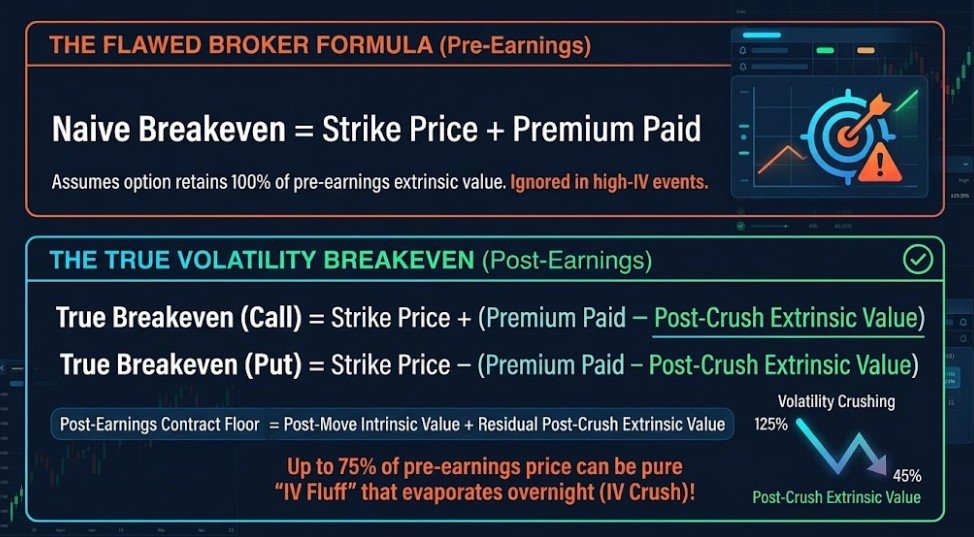
Naive Breakeven = Strike Price + Premium Paid
Why This Fails Across Binary Events
This equation assumes your contract will retain its pre-earnings extrinsic value after the news drops. In practice, up to 75% of an at-the-money (ATM) option’s price right before earnings is pure event-driven extrinsic fluff.
Once earnings are announced, that extrinsic premium deflates back toward baseline historical volatility. If the underlying stock rallies +3%, but your option required a +6.5% move just to replace the evaporated volatility premium with real intrinsic value, you take an unforced loss.
To protect yourself, calculate your position against the True Volatility-Adjusted Breakeven:
Post-Earnings Contract Floor = Post-Move Intrinsic Value + Residual Post-Crush Extrinsic Value
True Breakeven (Call) = Strike Price + (Premium Paid − Post-Crush Extrinsic Value)
True Breakeven (Put) = Strike Price − (Premium Paid − Post-Crush Extrinsic Value)
If an option contract retains almost zero extrinsic value after the announcement, the stock must move past the strike by almost the entire dollar amount of the initial premium paid just to break even.
Interactive Earnings IV Crush & Breakeven Simulator
Use this interactive tool to model your post-earnings contract pricing before placing the order. Toggle the underlying stock move slider to see whether your directional target overcomes expected volatility contraction.
⚡ Options IV Crush & Breakeven Simulator
Model the stock move needed to survive post-earnings IV drop.
Real-World Case Study: Trading TSLA vs. The Implied Move
To see this play out on actual market data, consider this common setup observed during earnings cycles:
- Underlying Stock Price: $220.00
- Pre-Earnings Implied Volatility: 125%
- Contract Purchased: 3 DTE $225.00 Call
- Premium Paid: $9.80 ($980 total cash outlay per contract)
- Market-Maker Implied Move: ±7.5% ($16.50)
The company beats expectations, and the stock opens the following morning at $231.00—a clean +5.0% gap to the upside.
The Trade Breakdown:
- Delta Gain: The stock rallied $11.00, pushing the strike $6.00 in the money ($231.00 − $225.00). The call now holds $6.00 in intrinsic value.
- Vega Destruction: Post-earnings IV immediately collapses from 125% down to its 45% historical average. The remaining extrinsic value plummets from $9.80 down to approximately $0.90.
- New Contract Price: $6.00 (Intrinsic) + $0.90 (Extrinsic) = $6.90.
- Net Trade Loss: Despite nailing a +5.0% directional rally on the underlying stock, the position loses -$2.90 per share, a -29.6% net loss.
Taking unexpected hits like this is often a symptom of sizing positions without accounting for worst-case volatility contractions. Establishing rigid account protections like our Irrevocable Cross-Broker Kill Switch ensures you systematically cap exposure before high-volatility event trades can damage your balance.
How to Trade Around Earnings Without Getting Crushed
If you want to trade earnings announcements, you must align your strategy with volatility dynamics rather than fighting against them:
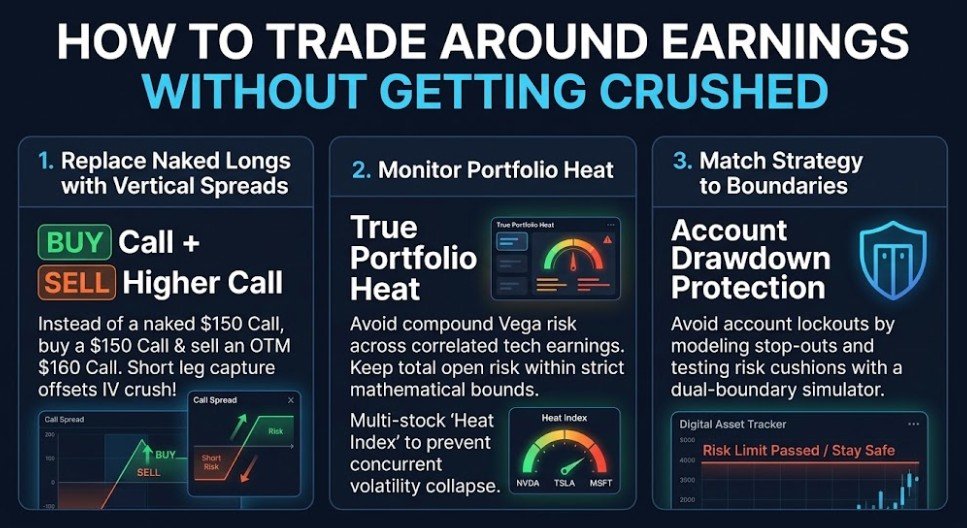
1. Replace Naked Longs with Vertical Spreads
Instead of buying a naked $150 Call, purchase a $150 Call and sell an out-of-the-money $160 Call against it. Because you are short the higher strike, IV crush works in your favor on that short leg, significantly offsetting the volatility loss on your long contract.
2. Monitor Portfolio Heat During Heavy Reporting Weeks
Holding multiple long-call or long-put positions across correlated tech earnings creates compound Vega risk. Ensure your total open risk stays within strict mathematical bounds using our True Portfolio Heat Calculator to verify that a simultaneous volatility collapse across several holdings cannot trigger a drawdown breach.
3. Match Strategy to Account Boundaries
If you trade under strict firm risk rules or trailing drawdown limits, naked long options around earnings are an unnecessary hazard. Model your stop-outs and evaluate your risk cushion with our Prop Firm Dual-Boundary Simulator to confirm that post-earnings volatility contractions will not force an account lockout.
Volatility FAQ Section
Post-Earnings Volatility FAQ
(Hide)
What causes implied volatility to drop so fast after earnings?
Show
Implied volatility reflects the market’s demand for insurance against unknown price shocks. The moment the earnings report is released, that specific unknown catalyst is resolved. Market participants stop paying exorbitant premiums for protection, causing market makers to immediately drop extrinsic values across all contract strikes.
Can an option still make money if IV gets crushed?
Show
Yes. An option will remain profitable through IV crush if the underlying stock makes an outsized move that exceeds the market-maker implied move. When the intrinsic value gained from the directional stock move surpasses the dollar value wiped out by volatility contraction, the trade closes net positive.
Does IV crush affect deep in-the-money (ITM) options?
Show
Deep in-the-money options are largely insulated from IV crush because their pricing is composed almost entirely of intrinsic value. Because their extrinsic value makes up a tiny fraction of the total premium, an overnight collapse in implied volatility has minimal dollar impact on the contract.
Are weekly options more vulnerable to IV crush than monthly options?
Show
Yes. Short-dated weekly options expiring immediately after an earnings event carry the highest concentration of binary event risk relative to their total cost. Longer-dated monthly contracts or LEAPS hold substantial baseline time value, meaning their implied volatility drops by a much smaller percentage.