Table of Contents (Show/Hide)
Table of Contents
1. The Psychology of Ruin: Why Willpower Alone Fails Active Traders
The financial markets are engineered to exploit cognitive vulnerabilities. When active traders search for solutions like how to lock myself out of trading account, an automated cross broker kill switch, or prevent revenge trading software, they are rarely addressing an analytical shortcoming. They are experiencing acute biological breakdowns in risk execution.
A trader can spend years mastering technical analysis, auction market theory, volume profile dynamics, and moving average cross-structures. Yet, a single 45-minute emotional lapse can erase four months of disciplined, consistent profitability. Understanding why willpower is an insufficient defense is the first step toward institutional capital preservation.
The Amygdala Hijack and the Neurobiology of “Tilt”
In high-stress market environments, unexpected financial loss triggers the brain’s acute survival response. The amygdala activates, overriding the prefrontal cortex—the region responsible for executive function, probabilistic reasoning, and long-term risk assessment.
When this “amygdala hijack” occurs:
- Risk Perception Inverts: Losses are no longer processed as normal statistical variance; they are perceived as personal threats that must be rectified immediately.
- Loss Aversion Weaponizes Sizing: According to Kahneman and Tversky’s Prospect Theory, the psychological pain of a loss is roughly twice as intense as the pleasure of an equivalent gain. To avoid crystallizing that pain, traders scale position size aggressively on the next entry (martingaling), hoping a single winning bounce restores their initial balance.
- Temporal Horizons Collapse: Long-term expectancy vanishes entirely. The trader’s focus narrows strictly to the next five minutes, resulting in trades placed far outside valid playbook setups.
The Non-Linear Mathematics of Drawdown Recovery
Traders frequently underestimate the severity of account depletion because losses feel linear, but recovery is exponentially non-linear.
The percentage gain required to recover from any given drawdown percentage (D) is defined by the following relation:
Required Recovery Gain (%) = [ D / (1 – D) ] × 100
Where D is expressed as a decimal (e.g., 0.20 for a 20% drawdown).
| Account Drawdown (D) | Capital Remaining | Required Gain to Breakeven | Practical Difficulty Level |
|---|---|---|---|
| 5% | 95.0% | 5.26% | Standard weekly variance; easily recovered |
| 10% | 90.0% | 11.11% | Achievable within standard risk models |
| 20% | 80.0% | 25.00% | Requires aggressive patience; multi-month recovery |
| 30% | 70.0% | 42.86% | Severe impairment; necessitates reduced sizing |
| 50% | 50.0% | 100.00% | Statistically fatal for over 85% of retail accounts |
| 75% | 25.0% | 300.00% | Account ruin; requires historic market outperformance |
A trader who loses 10% needs an 11.1% gain to recover. However, a trader who tilts into a 50% drawdown does not need a 50% gain—they must double their remaining capital (a 100% gain) merely to reach breakeven. Surviving the market requires an automated cross broker kill switch that stops drawdowns before they enter the exponential curve.
The Structural Broker Incentive: Why Platforms Won’t Stop You
Retail traders often ask: Why doesn’t my broker offer an automated daily loss cutoff that locks me out?
The answer lies in platform economics:
- Order Flow and Commissions: Brokers generate revenue from volume, contract fees, bid-ask spread captures, and Payment for Order Flow (PFOF). A tilted trader executing 60 round-trips an hour generates massive fee revenue for clearing houses.
- Margin and Financing Charges: Carrying distressed overnight positions or drawing on margin generates sustained interest income for the broker.
- Legal Liability of Premature Liquidation: If a broker automatically flattens an account due to an arbitrary algorithmic rule and the market immediately rebounds, they expose themselves to client disputes and regulatory complaints.
Brokers will forcefully liquidate you to protect their capital during a margin call. They will never liquidate you early to protect your capital.
2. What Is an Irrevocable Cross Broker Kill Switch?
An Irrevocable Cross Broker Kill Switch is a deterministic, tamper-resistant middleware layer designed to enforce risk rules across all active trading accounts simultaneously.

The Multi-Account Dispersion Dilemma
Modern day traders rarely operate out of a single broker. A typical trader might hold:
- An equity/options account on Charles Schwab or Thinkorswim.
- A futures day trading account on Tradovate or NinjaTrader.
- A portfolio margin swing account on Interactive Brokers (IBKR).
When a daily loss limit is hit on Tradovate, the tilted trader does not walk away. They simply close the futures platform, open Thinkorswim, and aggressively trade SPY zero-day-to-expiration (0DTE) options.
Without a unified cross broker kill switch and daily loss limit, single-platform guardrails are useless. Risk must be aggregated globally across every conduit of capital.
Client-Side Friction vs. Zero-Bypass Middleware
Traditional retail attempts to solve revenge trading rely on client-side friction:
- Browser extensions that block specific URLs.
- Operating system screen-time timers.
- Password lockers where a third party holds the account password.
These methods fail because they introduce friction, not impossibility. In an amygdala-hijacked state, a trader will uninstall the extension, reboot into safe mode, or reset the password via automated email retrieval in less than two minutes.
A true zero-bypass cross browser kill switch operates at the API and routing layer:
- Server-Side Authorization: The lockout rule resides outside the local operating system.
- Read-Only Telemetry Integration: Account balances and P&L streams are ingested via read-only REST/WebSocket API tokens.
- Emergency Liquidation Routing: If thresholds are crossed, an authenticated order cancellation and position flattening sequence routes directly to broker execution gateways.
- Token Self-Revocation: Once triggered, session access tokens are placed into a quarantine queue, preventing the trader from re-authenticating until the next market day’s opening bell.
Telemetry Ingestion and Automated Execution Liquidations
The software calculates aggregate net liquidation value in real-time across all connected brokers:
Net P&L (Global) = Total Realized P&L + Total Unrealized P&L (Across All Accounts)
If Net P&L (Global) drops to or breaches the pre-set Daily Loss Limit, the liquidation protocol fires deterministically:
- Cancel all open limit orders, stop brackets, and resting conditional orders across every broker.
- Transmit market orders to flatten all open intraday inventory.
- Lock account connectivity into read-only mode for a mandatory 24-hour quarantine window.
3. Quantitative Risk Frameworks: The Mathematics of Defense
Professional trading desks at proprietary firms do not view risk management as an act of will. It is calibrated as a quantitative survival function.
The Drawdown Recovery Multiplier Formulation
To evaluate the true cost of an uncontrolled trading session, we calculate the Recovery Friction Index (RFI):
Recovery Friction Index (RFI) = Required Recovery Return / Historical Monthly Alpha
If your trading system generates an average monthly return of 4.5%, and you allow a rogue tilt session to inflict an 18% drawdown:
- Required Gain to recover: 21.95%
- RFI = 21.95 / 4.5 = 4.87 months
A single day of emotional indiscipline costs you nearly five full months of flawless execution just to return to flat.
Risk of Ruin (RoR) Probability Calculation
The classic Risk of Ruin equation under fixed-fraction sizing assumes win rate (W), payoff ratio (R = Average Win / Average Loss), and total risk units (U):
Risk of Ruin (RoR) = [ (1 – A) / (1 + A) ] ^ U
Where Edge Advantage (A) = Win Rate – [ (1 – Win Rate) / Payoff Ratio ]
When a trader tilts, two critical inputs degrade simultaneously:
- Win Rate collapses because trades are taken impulsively at random price points.
- Payoff Ratio collapses because winning trades are cut instantly out of anxiety, while losing trades are held and averaged down.
- Edge Advantage becomes negative, driving the probability of absolute ruin asymptotically toward 100.0%.
The cross broker kill switch serves as a mechanical truncation of the left tail, artificially preventing the conditions where a negative edge advantage can deplete remaining risk units.
Fractional Kelly Sizing for High-Volatility Regime Protection
The Kelly Criterion calculates the mathematically optimal percentage of capital (K*) to allocate to a given setup:
Optimal Allocation (K*) = Win Rate – [ (1 – Win Rate) / Payoff Ratio ]
Because financial markets exhibit fat-tailed, non-Gaussian distributions, institutional desks never deploy Full Kelly (1.0 × K*), which carries extreme drawdown variance. Instead, they mandate Quarter Kelly (0.25 × K*) or Eighth Kelly (0.125 × K*).
4. Step-by-Step Calibration and Operating Protocol
To implement this protection on smartedgeintel.com or across your daily terminal setup, follow this four-stage operating protocol.
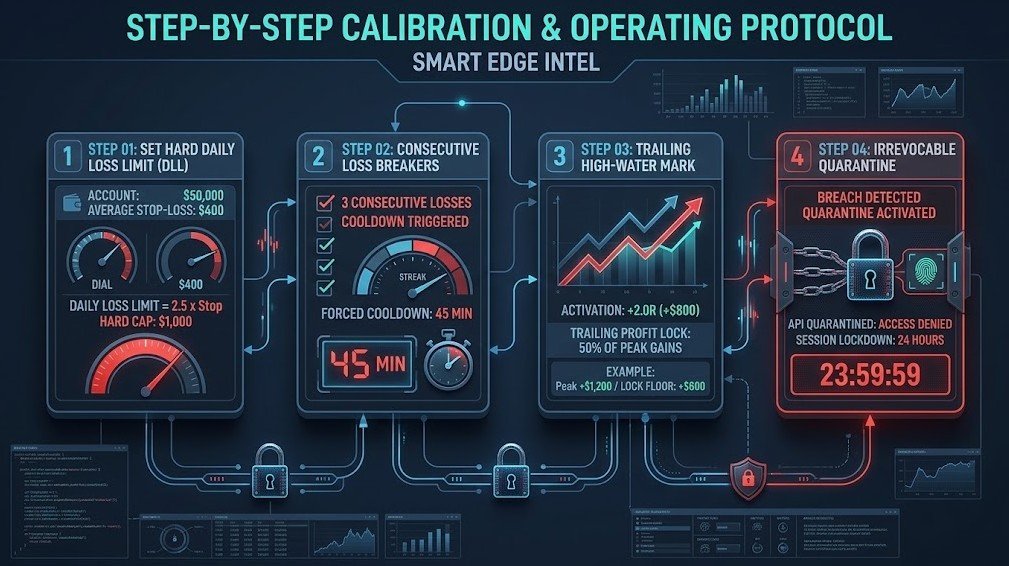
Step 1: Establishing the Hard Daily Loss Limit (DLL)
Your Daily Loss Limit must never be an arbitrary round number (e.g., “I’ll stop if I lose $1,000”). It must be derived directly from your strategy’s statistical distribution.
- Calculate Strategy R: Determine your average winning trade dollar value over your last 100 verified trades.
- Calculate Expected Drawdown per Session: In a standard positive-expectancy model, experiencing two to three consecutive losses falls within normal statistical variance. Four consecutive losses often indicates regime mismatch (e.g., trying to trade trend continuation during a mean-reverting range day).
- Set the Cap: Daily Loss Limit = 2.5 × Average Stop-Loss Amount Example: If your account size is $50,000 and your average stop-loss risk per trade is $400 (0.8% of account), your daily hard loss limit must be set at exactly $1,000 (2.0% of total capital).
Step 2: Consecutive Loss Circuit Breakers and Forced Cooldowns
Drawdown is not solely a function of dollars lost; it is a function of execution frequency. Three rapid losses within twenty minutes carries a radically higher probability of tilt than three losses spread across an entire trading day.
- Consecutive Loss Cap: Set to 3 consecutive losses.
- Action: Trigger an automated 45-minute execution cooldown. Orders cannot be routed, even if the daily dollar loss limit has not yet been reached. This allows cortisol levels to return to baseline and the amygdala hijack to subside.
Step 3: Trailing High-Water Mark Profit Locks
One of the most psychologically devastating occurrences in trading is giving back an exceptional morning gain and finishing the day deep in the red. This almost universally triggers immediate tilt and account-destroying revenge trades.
Implement a trailing high-water mark profit lock:
- Activation Threshold: Once net daily realized P&L reaches +2.0R (e.g., +$800 on a $400 risk unit).
- Trailing Lock Floor: Lock in 50% of peak gains.
- Example: If you peak at +$1,200, your daily exit floor automatically moves to +$600. If your account balance drops back to +$600, the system executes a profit-lock shutdown for the day. You walk away green.
Step 4: Activating Irrevocable Session Quarantine
Once a hard dollar limit, consecutive loss threshold, or trailing profit floor is breached, the cross broker kill switch executes a Session Quarantine:
- All browser charting and execution tabs are redirected to a read-only post-trade analysis screen.
- The interactive terminal locks inputs for a minimum countdown of 12 to 24 hours.
- A local and cloud audit log is written, recording the exact breach parameters for your weekend review.
5. Real-World Failure Modes: How Mechanical Enforcement Saves Capital
Case Study 1: The Opening Drive Reversal (FOMO to Revenge)
- The Setup: A trader plans to short TSLA below the pre-market low. At the 9:30 AM open, Tesla whipsaws, sweeps liquidity, and stops the trader out for a planned -$350 loss.
- The Human Failure: Convinced the initial bias was correct, the trader immediately doubles their position size to re-enter short at the market without confirmation. TSLA breaks upward into an aggressive squeeze. The second loss hits for -$1,100. Total drawdown is now -$1,450. Tilted, the trader flips long at the absolute peak of the squeeze. By 10:15 AM, the account is down -$3,800.
- The Cross Broker Kill Switch Interception:
- Loss 1 hits (-$350).
- Loss 2 hits (-$700). Total loss: -$1,050.
- The system detects breach of the configured $1,000 Daily Loss Limit.
- The platform instantly issues a cancel-all command, flattens the open position, and locks the interface until the next trading day.
- Capital Preserved: $2,750 saved from being surrendered to emotional chop.
Case Study 2: The Escalating Martingale Spread Catastrophe
- The Setup: An options trader sells an out-of-the-money credit spread on SPY expiring same-day (0DTE).
- The Human Failure: Macro headlines break, and the market trends aggressively against the short strikes. Instead of accepting the calculated max loss, the trader rolls the spread closer to the money, increases contract count from 10 to 40 contracts to lower breakeven, and removes the stop loss.
- The Cross Broker Kill Switch Interception: As soon as aggregate unrealized portfolio delta risk exceeds the pre-calibrated risk parameter, the guardian software triggers an automatic market liquidation. It absorbs a defined, controlled loss and completely prevents a catastrophic multi-thousand-dollar margin call.
Case Study 3: The Afternoon Chop “Giveback” Cycle
- The Setup: A futures day trader captures a clean opening trend on the E-mini S&P (ES), closing the morning session at +$1,650 net profit.
- The Human Failure: Boredom sets in during the 12:00 PM – 1:30 PM lunch lull. The trader enters low-probability range trades, taking multiple scratch and small losing trades. Down -$400 from the peak, irritation drives over-leverage on micro-swings. By 3:30 PM, the +$1,650 morning has turned into a -$850 red day.
- The Cross Broker Kill Switch Interception: The trailing profit lock was armed at +$1,000 with a 50% retracement stop. As soon as morning profits drifted down to +$825, the guardian locked the account for the remainder of the session, locking in a green day.
6. Prop Firm Mandates vs. Self-Directed Freedom
Proprietary trading firms (such as SMB Capital, Jane Street, or commercial evaluation firms like Topstep and Apex) understand that traders are fundamentally human. They do not rely on subjective promises to maintain discipline.
Institutional Desk Risk Mandates
On professional proprietary trading desks:
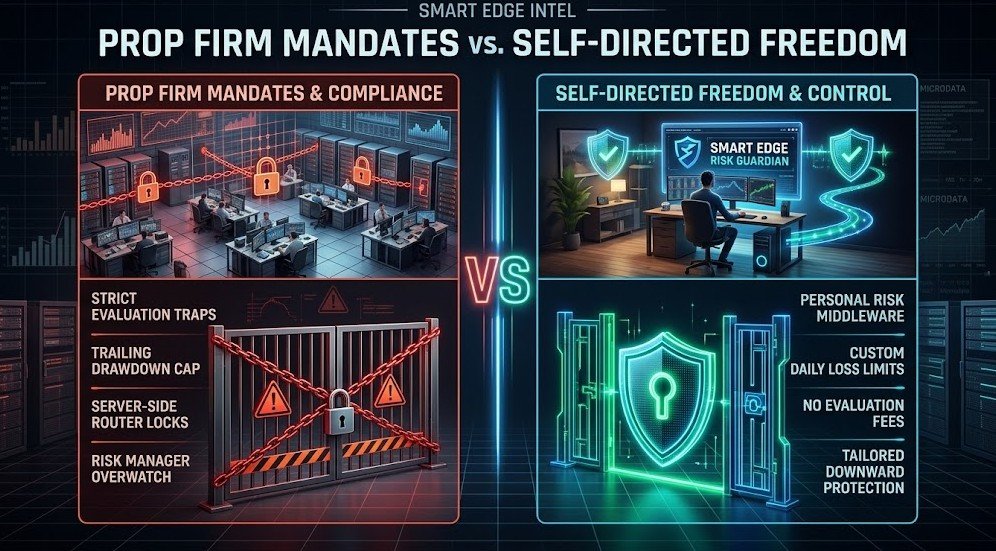
- The Risk Manager Holds the Keys: A physical risk manager sits on the floor monitoring live P&L matrices. If a junior trader breaches their daily loss threshold, the risk manager unplugs their connection at the server rack and sends them home for the day.
- Automated Risk Limits (EOD / Trailing): Trailing drawdown limits are hardcoded directly into the firm’s algorithmic clearing router. There is no negotiation or manual override.
Simulating Funded Account Discipline Without Evaluation Traps
Commercial prop firm evaluations often impose punishing trailing drawdown rules designed to make evaluation accounts fail. However, retail traders can adopt the healthy components of professional risk desks without paying evaluation fees:
- Treat your personal capital with the exact institutional rigor of a funded prop desk.
- Automate the role of the risk manager via dedicated software middleware.
- Make breaking your personal risk rules impossible by eliminating the choice to do so.
7. Operating the Smart Edge Intel Kill Switch Guardian
The embedded Cross Broker Kill Switch Guardian terminal on this page is built to replicate institutional server-side risk controls directly in your trading environment.
1. Risk Configuration
2. Live Telemetry
Configuring Account Balances and Stop Thresholds
- Aggregate Account Capital: Input your combined liquid trading capital across all connected brokerages (e.g., $50,000).
- Set Hard Daily Loss Cap: Configure your maximum tolerable daily loss in dollars (e.g., $1,000).
- Set Consecutive Loss Limit: Establish the maximum number of consecutive losses allowed before a mandatory circuit breaker fires (recommended: 3).
- Arm Trailing Profit Watermark: Toggle the profit protection slider to lock in 50% of daily gains once your target threshold is crossed.
Simulating Liquidation and Locking Your Terminal
- Use the Simulate Loss / Trade buttons in the testing console to verify that the mathematical engine tracks drawdowns accurately.
- If your configured stop is touched, the tool synthesizes an emergency audio alert, halts execution, and activates the Session Quarantine.
- The lockdown state persists locally via localStorage—preventing page reloads or simple browser restarts from resetting the protection.
8. Frequently Asked Questions (FAQ)
Can I manually override the cross broker kill switch if I see an exceptional setup?
No. An override button completely invalidates the psychology of the tool. If you can disable a cross broker kill switch while under the influence of tilt, you do not have a cross broker kill switch—you have a suggestion. The quarantine must remain active until the designated time lock expires.
How does this interact with overnight swing positions?
The Kill Switch Guardian distinguishes between intraday day-trading risk and long-term portfolio holding risk. Intraday rules apply strictly to positions tagged for day execution. Swing positions with structural, wide-bracket stop orders can be exempted from intraday liquidation routines.
Why not just use daily stop orders on my trading platform?
Platform stop orders only protect individual positions; they do not protect against behavior. After a stop order is filled, nothing stops a tilted trader from clicking “Buy Market” two seconds later. A kill switch manages the trader, not just the trade.
Which brokers support external API-level execution cutoffs?
Interactive Brokers (via Client Portal API / TWS API), Tradovate (via WebSocket REST API), and ProjectX/Rithmic connections provide the programmatic endpoints necessary to cancel resting orders and issue market flatten commands programmatically.
9. Conclusion: Turning Defense into Your Greatest Edge
Long-term success in the financial markets is not determined by how much you make on your best days. It is determined entirely by how much you lose on your worst days.
Professional traders build durable wealth because their downside is capped with mechanical certainty. By implementing a cross broker kill switch, you remove the human flaw of emotional revenge trading and ensure that your trading business survives to compound profits over decades.